Showing posts with label Program. Show all posts

Wednesday, 28 August 2024

What is Cloud Computing and How Does It Work?

 What is Cloud Computing and How Does It Work?

Cloud computing is a technology that allows users to access and store data, applications, and computing resources over the internet, rather than on a local computer or server. The "cloud" refers to servers that are accessed over the internet and the software and databases that run on those servers.

How Does Cloud Computing Work?

  1. Service Models: Cloud computing is typically offered in three main service models:

    • Infrastructure as a Service (IaaS): Provides virtualized computing resources over the internet, such as virtual machines, storage, and networks. Examples include AWS EC2, Microsoft Azure, and Google Compute Engine.
    • Platform as a Service (PaaS): Offers a platform allowing customers to develop, run, and manage applications without dealing with the infrastructure. Examples include Google App Engine, Microsoft Azure App Services, and Heroku.
    • Software as a Service (SaaS): Delivers software applications over the internet, typically on a subscription basis. Examples include Google Workspace, Microsoft Office 365, and Salesforce.

  2. Deployment Models: Cloud computing can be deployed in various ways:

    • Public Cloud: Services are offered over the public internet and are available to anyone who wants to purchase them. This model provides high scalability and cost-effectiveness.
    • Private Cloud: Services are maintained on a private network and are used exclusively by a single organization. This model offers enhanced security and control.
    • Hybrid Cloud: Combines public and private clouds, allowing data and applications to be shared between them. This model provides flexibility and more deployment options.
  3. Working Mechanism: Cloud computing works by virtualizing physical computing resources such as servers and storage. Virtual machines and containers run on these resources, and data is stored in cloud-based storage systems. Users access these resources via the internet using web browsers or dedicated applications.

Why Use Cloud Computing?

  • Scalability: Easily scale resources up or down based on demand.
  • Cost Efficiency: Pay only for what you use, reducing capital expenditure.
  • Accessibility: Access resources from anywhere, on any device, with an internet connection.
  • Disaster Recovery: Cloud providers often offer robust backup and recovery options.
  • Security: Many cloud providers offer advanced security features to protect data.
Monday, 26 August 2024

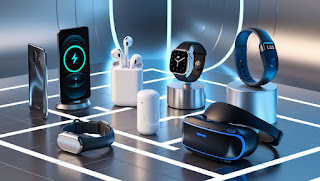
Here are some of the best tech gadgets that are popular and useful across different categories


 Here are some of the best tech gadgets that are popular and useful across different categories 

1. Smartphones

  • Apple iPhone 14 Pro/Pro Max: Known for its powerful performance, high-quality camera system, and seamless integration with other Apple devices, the iPhone 14 Pro series is a top choice for smartphone users.
  • Samsung Galaxy S23 Ultra: Featuring a large, vibrant display, an advanced camera system with high zoom capabilities, and a powerful processor, the Galaxy S23 Ultra is a great option for Android enthusiasts.

2. Laptops

  • Apple MacBook Air (M2, 2023): The MacBook Air with Apple's M2 chip offers excellent performance, a sleek design, and long battery life, making it perfect for students, professionals, and casual users.
  • Dell XPS 13 (2023): Renowned for its compact design, stunning display, and robust performance, the XPS 13 is one of the best Windows laptops available.

3. Smartwatches

  • Apple Watch Series 8: With its comprehensive health and fitness tracking features, seamless integration with iOS devices, and new temperature sensor for cycle tracking, the Apple Watch Series 8 is the best smartwatch for iPhone users.
  • Samsung Galaxy Watch 6: Offering robust fitness tracking, a vibrant display, and compatibility with Android devices, the Galaxy Watch 6 is a top choice for Android users.

4. True Wireless Earbuds

  • Sony WF-1000XM5: Known for its industry-leading noise cancellation, superb sound quality, and long battery life, the Sony WF-1000XM5 is one of the best wireless earbuds on the market.
  • Apple AirPods Pro (2nd Generation): With improved sound quality, active noise cancellation, and seamless connectivity with Apple devices, the AirPods Pro (2nd Gen) are a great choice for iOS users.

5. Tablets

  • Apple iPad Pro (2023): Featuring a powerful M2 chip, a stunning Liquid Retina display, and support for the Apple Pencil 2, the iPad Pro is the best tablet for creative professionals and power users.
  • Samsung Galaxy Tab S9 Ultra: With a large AMOLED display, excellent performance, and S Pen support, the Galaxy Tab S9 Ultra is ideal for Android users looking for a versatile tablet.

6. Smart Home Devices

  • Amazon Echo (4th Generation): With improved sound quality, a built-in smart home hub, and integration with Alexa, the Amazon Echo is an excellent choice for those looking to create a smart home ecosystem.
  • Google Nest Hub (2nd Generation): This smart display offers Google Assistant integration, sleep tracking, and controls for compatible smart home devices, making it a great addition to any smart home.

7. Gaming Consoles

  • PlayStation 5: Sony's latest console offers impressive graphics, fast load times, and a growing library of exclusive games, making it a top choice for gamers.
  • Xbox Series X: Known for its powerful hardware, backward compatibility, and Xbox Game Pass subscription service, the Xbox Series X is a great option for gamers looking for value and performance.

8. Fitness Trackers

  • Fitbit Charge 5: With features like heart rate monitoring, GPS tracking, and sleep analysis, the Fitbit Charge 5 is a great choice for those looking to track their fitness and health.
  • Garmin Vivosmart 5: Ideal for outdoor enthusiasts, the Vivosmart 5 offers advanced fitness tracking features, long battery life, and a durable design.

9. Portable Chargers

  • Anker PowerCore 10000: Compact, lightweight, and powerful, the Anker PowerCore 10000 can charge most smartphones multiple times and is a great travel companion.
  • Zendure SuperTank Pro: With a massive capacity, multiple output ports, and fast charging capabilities, the SuperTank Pro is ideal for charging multiple devices on the go.

10. E-Readers

  • Amazon Kindle Paperwhite (11th Generation): With a high-resolution display, adjustable warm light, and long battery life, the Kindle Paperwhite is the best e-reader for avid readers.
  • Kobo Clara HD: Offering a similar reading experience to the Kindle with support for more file formats and OverDrive integration for borrowing library books, the Kobo Clara HD is a great alternative.

Thursday, 24 August 2017

Write a program to generate a class named Person (with data numbers: Name, Age) and compare the age of two persons and show the eldest one, using this pointer.

Figure 9
Coding:

#include<iostream.h>
#include<stdio.h>
#include<conio.h>
class Person
{
   char Name[20];
   int Age;
public:
  void getData()
  {
    cout<<"Enter Person Name:";
    gets(Name);
    cout<<"Enter Person Age:";
    cin>>Age;
  }
  void putData()
  {
   cout<<"\n\nDetails About Eldest Person as follows:";
   cout<<"\nName="<<Name<<"\nAge="<<Age;
  }
  Person &Compare(Person &p1)
  {
   if(p1.Age>this->Age)
   return p1;
   return *this;
  }
};


void main()
{
  clrscr(); Person x,y,z;
  x.getData();
  y.getData();
  z=x.Compare(y);
  z.putData();
  getch();
}


Output:

Saturday, 22 July 2017

Write a program to calculate the area of different shapes (circle, square, triangle, rectangle) using function overloading.

Coding:

#include<iostream.h>
#include<math.h>

#include<conio.h>
#define PI 3.141
class Shape
{
 float a;
 public:
    void area(int r);
    void area(float s);
    void area(float l,float b);
    void area(float a,float b,float c);
};
void Shape::area(int r)
{
  a=float(PI*r*r);
  cout<<"\nArea of Circle is:"<<a;
}
void Shape::area(float s)
{
 a=pow(s,2);
 cout<<"\nArea of Square is:"<<a;
}
void Shape::area(float l,float b)
{
  a=l*b;
  cout<<"\nArea of Rectangle is:"<<a;
}
void Shape::area(float a,float b,float c)
{
  float s;
  s=(a+b+c)/2;
  a=sqrt(s*(s-a)*(s-b)*(s-c));
  cout<<"\nArea of Tringle is:"<<a;
}
void main()
{
  clrscr();
  float k=6.5;
  Shape s;
  s.area(5);
  s.area(k);
  s.area(5,6.5);
  s.area(10,15.5,6.8);
  getch();
}


Output:


Wednesday, 7 June 2017

Create two classes DM and DB which store the value of distances. DM stores distances in metres and centimeters and DB in feet and inches.

Write  a program that can read values for the class  objects and add one object DM with another object of DB. Use a Friend Function to carry out  the addition operation. The object that stores the results may be a DM object or DB object, depending on the units in which the


Coding:

#include<iostream.h>
#include<conio.h>
class DB;
class DM
{
 float meter,centi;
 public:
 void getdata()
 {
  cout<<"\nEnter the distance in(meter-centimeter):";
  cin>>meter>>centi;
 }
 void display()
 {
  cout<<"\nThe distance is:";
  cout<<meter<<" meters and "<<centi<<" centimeter";
 }
 friend void add(DM &,DB &);
};
class DB
{
 float inch,feet;
 public:
 void getdata()
 {
  cout<<"\nEnter the distance in(feet-inch):";
  cin>>feet>>inch;
 }
 void display()
 {
  cout<<"\nThe distance is:";
  cout<<feet<<" feet and "<<inch<<" inch";
 }
 friend void add(DM &,DB &);
};
void add(DM &a,DB &b)
{
 int ch;
 cout<<"\nPress 1 for meter-centi:";
 cout<<"\nPress 2 for feet-inch:";
 cout<<"\nEnter your choice:";
 cin>>ch;
 if(ch==1)
 {
  DM d;
  int c=(a.meter*100+a.centi+b.feet*30.48+b.inch*2.54);
  if(c>=100)
  {
   d.meter=c/100;
   d.centi=c%100;
  }
  else
  {
   d.meter=0;
   d.centi=c;
  }
  d.display();
 }
 else
 {
  DB d;
  int i=(a.meter*39.37+a.centi*.3937008+b.feet*12+b.inch);
  if(i>=12)
  {
   d.feet=i/12;
   d.inch=i%12;
  }
  else
  {
   d.feet=0;
   d.inch=i;
  }
  d.display();
 }
}
void main()
{
 clrscr();
 DM a;
 DB b;
 a.getdata();
 b.getdata();
 add(a,b);
 getch();

}


Output:


Friday, 19 May 2017

Write a Program to implement first Pattern Matching Algorithm to find the location of Given Pattern (P) in A Given Text (T).

Coding:

#include<iostream.h>
#include<string.h>
#include<stdio.h>
#include<conio.h>
#include<stdlib.h>
void main()
{
  clrscr();
  int k,max,index,t_len,p_len;
  char a[50],p[10];
  cout<<"\nEnter any text:";
  gets(a);
  cout<<"\nEnter pattern:";
  gets(p);
  t_len=strlen(a);
  p_len=strlen(p);
  k=0;
  max=t_len-p_len+1;
  while(k<max)
  {
   for(int i=0;i<p_len;i++)
   {
    if(p[i]!=a[k+i])
    {
      index=0;
      k++;
      break;
    }
    else
    {
      index=k;
      cout<<"\nPattern is exist In given text and position is:"<<index;
      getch();
      exit(0);
    }
   }
  }
  if(index==0)
  cout<<"\nPattern does not Exist:";
  getch();
 }


Output: